Press Release · Global Wellness Institute
The Global Wellness Economy Hits New Record of $7.5 Trillion and Is Forecast to Reach $10.9 Trillion by 2030
Distributed by Prime News Global · Originally issued via PR Newswire
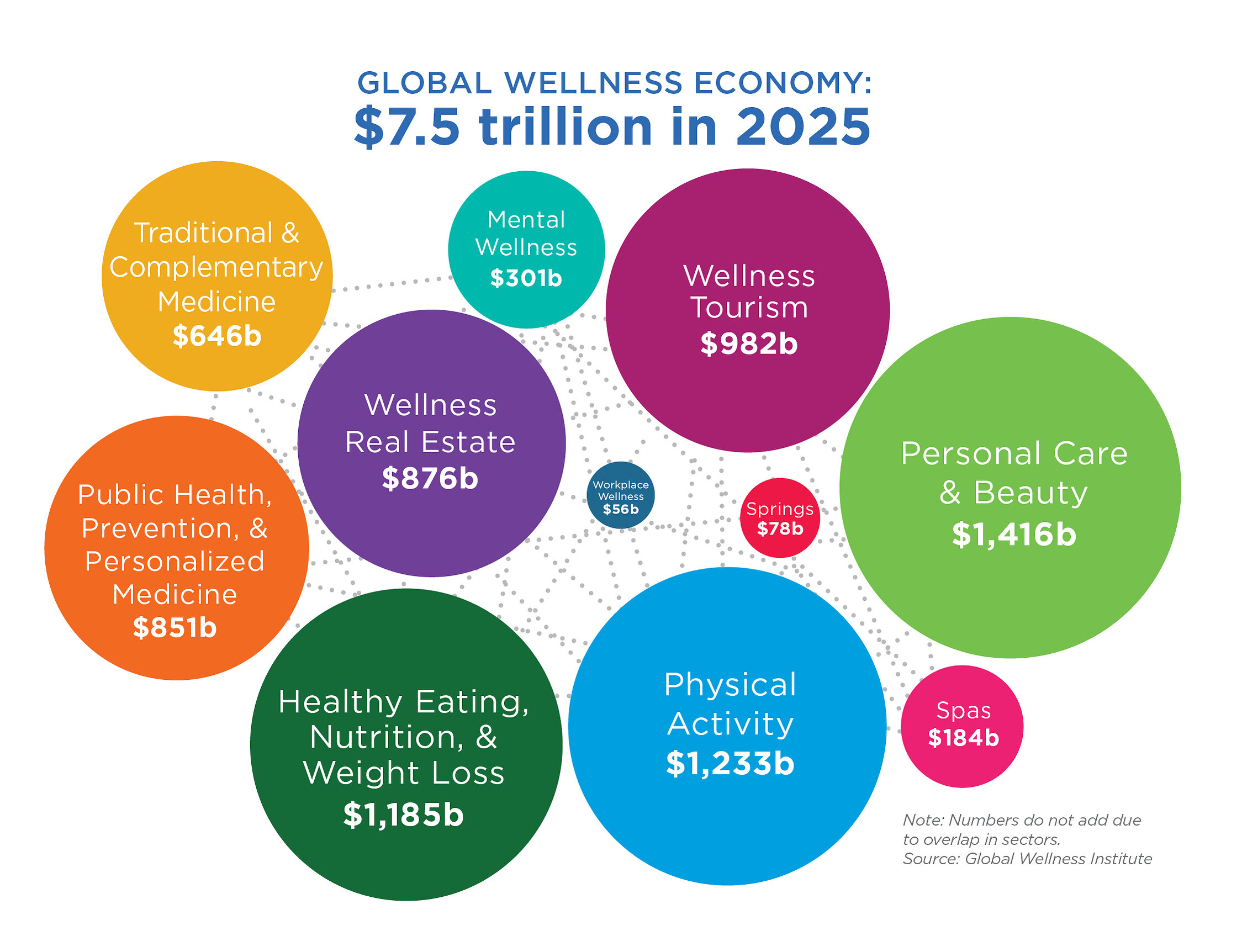
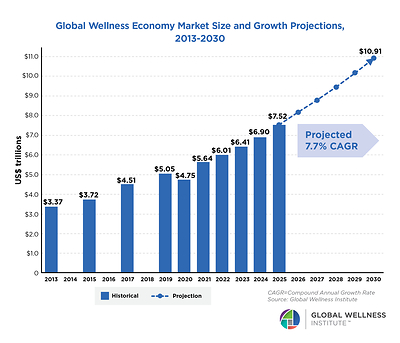
The Global Wellness Institute's new report—its most in-depth ever—reveals relentless growth for the wellness market: it expanded 49% since 2019 (6.9% annually) with even bigger annual gains (7.7%) expected through 2030, when seven wellness markets will top $1 trillion. The recent and future growth stars? Wellness real estate and mental wellness.
PHUKET, Thailand and MIAMI, Nov. 10, 2026 — The Global Wellness Institute (GWI) today released its Global Wellness Economy Monitor 2026, providing all new data, insights and future projections for the global wellness market and for each of its 11 sectors. If the wellness market has surged since the pandemic, the new research shows that its growth is only accelerating. The wellness economy grew 8.9% from 2024 to 2025, reaching a new peak of $7.5 trillion. It's on a trajectory to reach $8.2 trillion by year-end 2026 and approach $11 trillion by 2030. Worldwide, people are spending 2.2 times more on wellness than they were in 2013, when GWI first measured the market.
Ten of 11 wellness sectors (excluding workplace wellness) clocked impressive gains since 2019 and also year-over-year. The explosive growth leaders are wellness real estate—which is an astounding 3.5 times larger market than in 2019—and mental wellness, which nearly doubled during the same time. The biggest YoY gainers (2024-2025) are: 1) wellness real estate (23.2%), spas (12.8%), wellness tourism (11.4%) and mental wellness (11%).
Every regional wellness market has experienced powerful growth since 2019. Europe (12.3%), Middle East-North Africa (11.3%) and Asia (9.7%) posted the biggest year-over-year gains.
Wellness—A Growing Economic Force: To put the size of the wellness economy in perspective, it's now nearly four times larger than the global pharmaceutical industry ($1.94 trillion) and 61% as large as all global health expenditures (consumer and government spending combined at $12.3 trillion). Each year wellness comprises an ever-larger share of the world economy: it represented 4.3% of GDP in 2013 and 6.36% in 2025—and GWI estimates it will make up 7.21% by 2030.
The predicted biggest market gainers through 2030, by annual growth rate, are wellness real estate (15.3%), mental wellness (12.6%), thermal/mineral springs (9.8%) and traditional & complementary medicine (9.1%).
Wellness Economy Size & Growth Projections—2013-2030
2013: $3.4 trillion
2019: $5 trillion
2023: $6.4 trillion
2024: $6.9 trillion
2025: $7.5 trillion
Projected 2030: $10.9 trillion
"While it may seem like we've reached 'peak wellness,' the reality is that the wellness economy will continue to explode over the next five years, because this growth is not simply a consumer trend," said Katherine Johnston, GWI senior research fellow. "Powerful structural forces across every region of the world will accelerate demand in the coming years: rapidly aging populations, over-burdened healthcare systems and rising rates of chronic disease, stress and mental health challenges. These pressures make prevention, healthspan and healthy living environments more critical than ever."
The 160-page report is GWI's most detailed yet and includes growth trends and forecasts for all 11 wellness markets, as well as sub-sector breakdowns, regional data and the top 20 national markets for most wellness sectors. For 2026, chapter two is greatly expanded: packed with analyses of the specific trends and market shifts shaping each wellness sector, now and into the future.
Download the free report HERE.
Access graphs HERE.
Growth by Wellness Market, 2019-2025
2019 | 2024 | 2025 | Annual growth 2019-2025 | |
Personal Care & Beauty | $1.1T | $1.3T | $1.4T | 5.0 % |
Physical Activity | $903B | $1.1T | $1.2T | 5.3 % |
Healthy Eating/Nutrition/Weight Loss | $909B | $1.1T | $1.2T | 4.5 % |
Wellness Tourism | $656B | $882B | $982B | 6.9 % |
Wellness Real Estate | $246B | $711B | $876B | 23.5 % |
Public Health/Prevention/Personalized Med. | $586B | $814B | $851B | 6.4 % |
Traditional & Complementary Medicine | $480B | $603B | $646B | 5.1 % |
Mental Wellness | $153B | $271B | $301B | 11.9 % |
Spas | $120B | $163B | $184B | 7.3 % |
Thermal/Mineral Springs | $65B | $71B | $78B | 3.2 % |
Workplace Wellness | $52B | $55B | $56B | 1.3 % |
The growth of wellness real estate since 2019 (ranked #1 at 23.5% yearly) is nothing short of incredible. The pandemic ignited a sea change in people's thinking about the impact of external environments on their health. Wellness real estate has since moved from niche to mainstream, expanded into every real estate class, and jumped from the seventh- to the fifth-largest wellness market in the last three years.
In our age of immense stressors and permacrises, it's no surprise that mental wellness is the #2 growth star (12% annually). Mental wellness segments with especially strong annual growth since 2019 include cannabis (23%), meditation & mindfulness (14%) and sleep (13%). The US mental wellness market ($139 billion) dwarfs all other countries, with China a distant second at $18 billion.
Four markets are classified as the "mature and steady growth sectors": personal care and beauty; physical activity; healthy eating, nutrition and weight loss; and traditional and complementary medicine—each experiencing strong annual growth (roughly 5%) from 2019 to 2025.
The tourism-based sectors—wellness tourism, spas and thermal/mineral springs—took the longest to recover from the pandemic but are storming back. From 2024 to 2025, they were three of the five fastest growing wellness markets, with spas (#2) growing 12.8%, wellness tourism (#3) expanding 11.4% and thermal/mineral springs (#5) growing 10.4%. Every region in the world hit new records for both wellness tourism revenues and trips in 2025. The US accounts for 36% of all wellness tourism spend, but the Middle East-North Africa (21.5% growth from 2024 to 2025), Sub-Saharan Africa (18.1%) and Asia (15.6%) saw the biggest percentage gains in the last year.
Workplace wellness, with 1.3% annual growth, stands out as the only stagnant market. This reflects employers' adoption of more meaningful, holistic approaches to employee wellbeing that reach far beyond a "program," as well as the surge in remote and "gig" work, which leaves more employees without such benefits.
Per capita spending on wellness is vastly higher in North America ($6,419) and Europe ($2,149) compared to other regions (e.g., $635 in Latin America-Caribbean, $527 in Asia-Pacific and $440 in Middle East-North Africa).
The report contains extensive sub-sector data, from how mindful movement—now a $56 billion market, recently fueled by the Pilates craze—has been the fastest-growing segment within physical activity. To how the personalized medicine segment—thanks to the boom in preventative diagnostics and longevity programs—is now worth $364 billion, growing 7.7% in the last year.
Which Wellness Markets Will Grow Fastest? (Projections 2025-2030)
2025 | 2030 | Avg. annual growth | |
Personal Care & Beauty | $1.4T | $1.8T | 5.1 % |
Wellness Real Estate | $876B | $1.8T | 15.3 % |
Physical Activity | $1.2T | $1.6T | 5.5 % |
Healthy Eating/Nutrition/Weight Loss | $1.2T | $1.6T | 6.2 % |
Wellness Tourism | $982B | $1.4T | 7.1 % |
Public Health/Prevention/Personalized Med. | $851B | $1.2T | 6.7 % |
Traditional & Complementary Medicine | $646B | $1.0T | 9.1 % |
Mental Wellness | $301B | $544B | 12.6 % |
Spas | $184B | $270B | 8.0 % |
Thermal/Mineral Springs | $78B | $124B | 9.8 % |
Workplace Wellness | $56B | $62B | 2.2 % |
The wellness economy's annual growth rate of 7.7% through 2030 will be 50% faster than the expansion of global GDP. Wellness real estate will remain the #1 gainer with 15.3% annual growth, more than doubling in size by 2030. A striking forecast: the sector will jump from its current position as the fifth-largest wellness market to the second largest, trailing only beauty and personal care.
Mental wellness is pegged as the second-fastest growing market through 2030 (12.6% annually). All three tourism-based sectors have powerful annual growth projections: spas at 8% and wellness tourism at 7.1%. Thermal/mineral springs is the standout with 9.8% projected annual growth, as the social bathing mania shows no signs of relenting and hundreds of new destinations are in the pipeline.
Traditional & Complementary Medicine will be the fourth-fastest gainer (9.1% annually), not only because Ayurveda, TCM and herbal medicines are rising but because the category includes all the spawning longevity and biohacking approaches—from infrared light therapy to cryotherapy.
The personalized medicine subsector will grow an eye-opening 9.3% each year, as consumers continue to rush to longevity and healthspan solutions. But, the report notes, the global longevity movement is evolving along two very different paths: in the US and other Western countries, it's being marketed as an individual consumer opportunity, while in parts of Asia and the Middle East, healthy longevity is being invested in as a much broader societal and economic challenge.
Today, three sectors in the wellness economy are worth over a trillion dollars. But by 2030, seven sectors will be: personal care & beauty; wellness real estate; physical activity; healthy eating, nutrition & weight loss; wellness tourism; public health, prevention & personalized medicine; and traditional & complementary medicine.
Research Sponsors: This research was made possible by these leading companies: ALDAR Properties PJSC, Amway, Anantara Hotels & Resorts, Banyan Group, Carillon Miami Wellness Resort, Chenot, Fountain Life, Hyatt, Life Longevity, Mather, Montage, Montara Hospitality Group, NADclinic, Rancho La Puerta, Sable Investments, Six Senses, Technogym, ULYSSIA and Universal Companies.
SOURCE Global Wellness Institute
About the Global Wellness Institute: The Global Wellness Institute (GWI), a nonprofit 501(c)(3), is considered the leading global research and educational resource for the global wellness industry and is known for introducing major industry initiatives and regional events that bring together leaders to chart the future. GWI positively impacts global health and wellness by educating public institutions, businesses and individuals on how they can work to prevent disease, reduce stress and enhance overall quality of life. Its mission is to empower wellness worldwide.